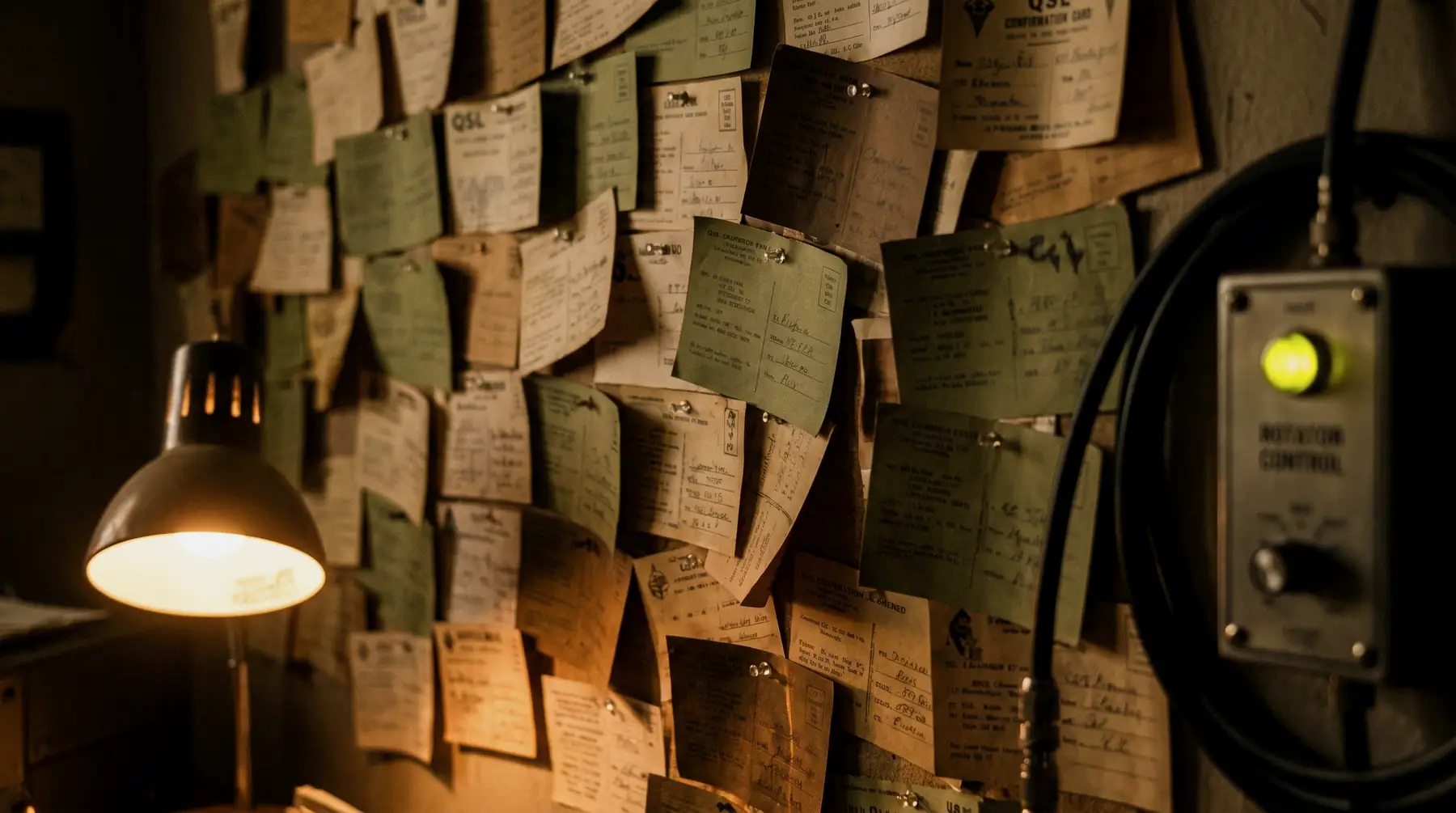
CX22OP
PX-07
Field Manual
Ham Radio
A licensed radio service, operated by civilians, that answers to no carrier and needs no network. When the towers are down and the cables are cut, it is still on the air — because it never depended on either.
// 01
The Service
A communications capability you are licensed to operate yourself.
Amateur radio is a licensed, non-commercial radio service. The state issues you a call sign, allocates you slices of spectrum, and then largely gets out of the way. What you build on that allocation is yours to design, test and repair.
Operators work each other across a street, across a country and across an ocean, on equipment they often built or modified themselves. Nothing in the chain belongs to a service provider. There is no subscription to lapse, no exchange to fail, and no operator to route around you.
Licensed
Spectrum granted to an individual, not a company.
Non-commercial
No traffic for hire. Experimentation, training, service.
Self-supported
Your antenna, your power, your maintenance.
Worldwide
One licence, a global operating community.
// 02
Enlisting
There is no gatekeeping — only a syllabus.
Anyone with an interest in radio, electronics or communications can qualify. Age is not a barrier at either end. What is required is a licence, and the licence is earned by examination rather than granted by connection.
01
Learn the syllabus
Radio theory, regulations and operating practice. The material is public and the exam is set against it — no course is mandatory, though a club will get you there faster.
02
Attach yourself to a club
Local clubs run classes, lend equipment, and put a first signal on the air under supervision. Most operators trace their start to one.
03
Get on the air with others
Nets, field days and contests are where operating is actually learned. Listening is a skill; so is being brief.
04
Sit the examination
Pass, pay the fee, receive a call sign. From that point the allocation is yours to operate.
// 03
Licensing · India
From application to call sign.
In India the Wireless Planning and Coordination wing of the Department of Telecommunications issues amateur licences. The whole process runs through the government's Saral Sanchar portal.
Saral Sanchar — Department of Telecommunications
01
Apply on Saral Sanchar
The official DoT portal. Register, and select the Amateur Radio Service.
02
Sit the online examination
Radio theory and regulations, taken at a scheduled session.
03
Clear the formalities
Pass the exam, complete police verification, and pay the prescribed fee.
04
Receive your call sign
The licence is issued with a call sign that identifies you on the air, anywhere in the world.
Foundation
Restricted
The entry grade. A working licence with a reduced privilege set — enough to get on the air and learn on real spectrum.
Intermediate
General
The standard grade. Wider band access and higher permitted power; where most operators settle.
Advanced
HAREC
Harmonised to the European certificate, which makes reciprocal operation abroad far simpler.
// 04
Allocation
The spectrum you are handed.
Each band behaves differently, and the difference is physics rather than preference. The low bands carry at night and over ground; the high bands need an ionosphere in the right mood and then reach the other side of the planet on a few watts. VHF and above are line of sight, repeaters and satellites.
| Band | Frequency | Modes | Typical use |
|---|---|---|---|
| 160 m | 1.810 – 2.000 MHz | CW · SSB · Digital | Long-haul at night, regional groundwave |
| 80 m | 3.500 – 4.000 MHz | CW · SSB · Digital | DX after dark, rag chews, nets |
| 40 m | 7.000 – 7.200 MHz | CW · SSB · Digital | DX, contests, the reliable workhorse |
| 20 m | 14.000 – 14.350 MHz | CW · SSB · Digital | Worldwide DX, open in daylight |
| 15 m | 21.000 – 21.450 MHz | CW · SSB · Digital | DX when the solar flux is up |
| 10 m | 28.000 – 29.700 MHz | CW · SSB · FM · Digital | Sporadic-E, long DX on low power |
| 6 m | 50.000 – 54.000 MHz | FM · Digital | The magic band — local, then suddenly not |
| 2 m | 144.000 – 146.000 MHz | FM · Digital | Local work, repeaters, emergency nets |
| 70 cm | 430.000 – 440.000 MHz | FM · Digital | Local work, repeaters, data links |
| 23 cm | 1240 – 1300 MHz | FM · Digital | Weak signal, experimentation |
| Microwave | Above 1 GHz | Various | Experimentation, EME, satellite |
Allocations follow WPC / DoT and are subject to change. Always operate against the current notification, not against a summary — this one included.
// 05
When It Matters
The network that is still up when the networks are down.
Commercial communications share a failure mode: they depend on infrastructure that is itself in the disaster. Towers lose power, backhaul is cut, exchanges flood, and the network that worked yesterday is a dead handset today.
Amateur radio has none of those dependencies. An operator with a battery, a wire and a licence is a working link, and a hundred of them are a working network — one that has carried traffic out of floods, cyclones and earthquakes when nothing else could.
No infrastructure
Battery, antenna, operator. That is the whole chain.
Trained volunteers
Nets and field days are the drill; the emergency is the exercise.
Interoperable
Works alongside disaster management authorities, NGOs and local units.
Proven
Search and rescue, relief coordination, medical traffic, welfare messages.
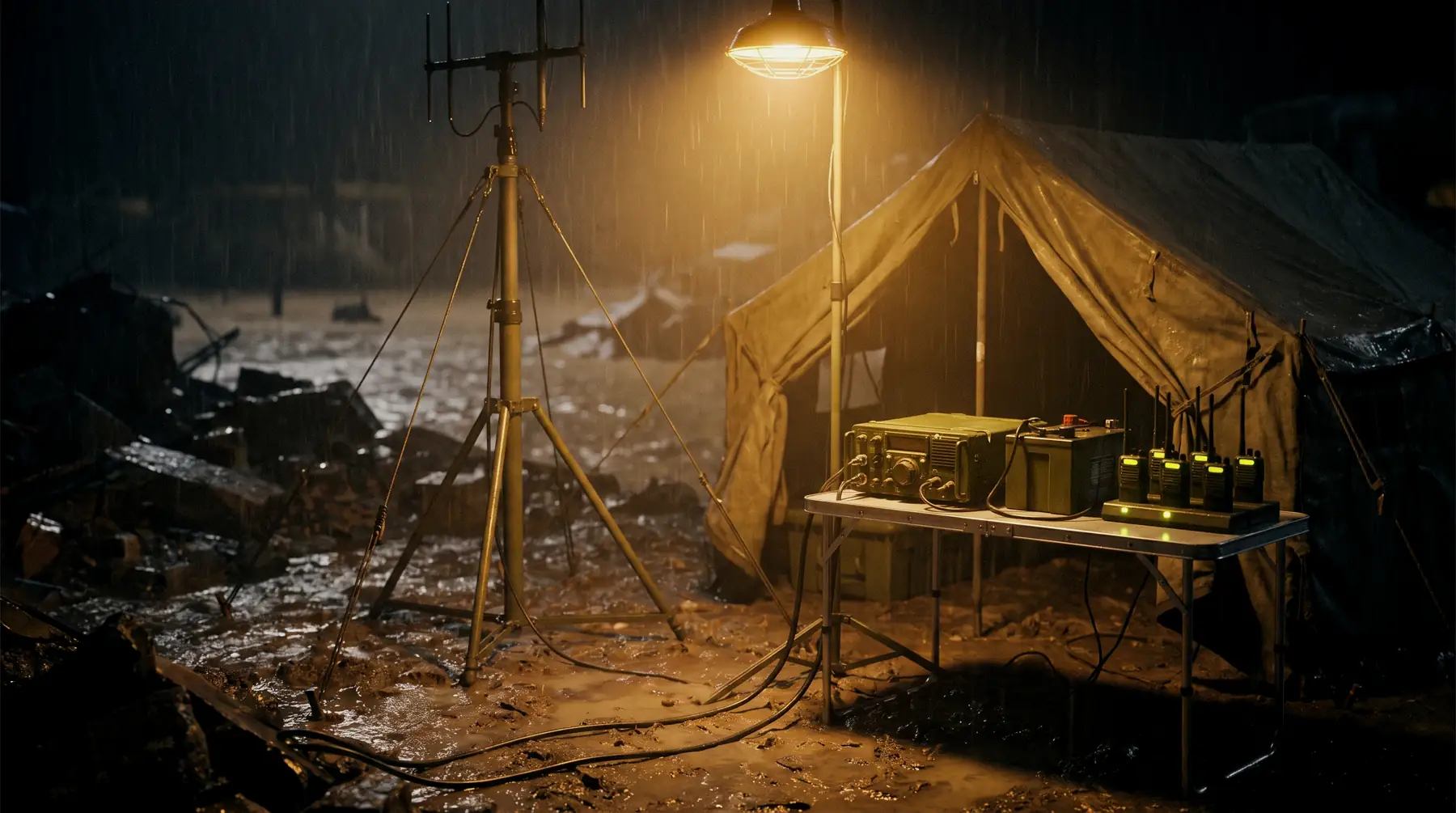
“Hams serve when others cannot.”
// FAQ
Straight Answers
Asked and answered.
What is ham radio?
Ham radio, or amateur radio, is a licensed non-commercial radio service. A national regulator issues an individual operator a call sign and access to allocated slices of spectrum, which they may use for communication, experimentation, training and public service — but not for commercial traffic. Operators supply and maintain their own equipment, so the service does not depend on any carrier or network.
How do I get an amateur radio licence in India?
Apply through the Department of Telecommunications' Saral Sanchar portal and select the Amateur Radio Service. Sit the online examination covering radio theory, regulations and operating practice, complete police verification, and pay the prescribed fee. On success the WPC wing issues your licence together with a call sign.
What licence grades exist in India?
Three. Restricted grade is the entry level with a reduced privilege set. General grade is the standard licence, with wider band access and higher permitted power. HAREC is harmonised with the European certificate, which simplifies reciprocal operation abroad.
Which frequency bands can Indian hams use?
The HF allocations run 160 m (1.810–2.000 MHz), 80 m (3.500–4.000 MHz), 40 m (7.000–7.200 MHz), 20 m (14.000–14.350 MHz), 15 m (21.000–21.450 MHz) and 10 m (28.000–29.700 MHz). Above them sit 6 m (50–54 MHz), 2 m (144–146 MHz), 70 cm (430–440 MHz), 23 cm (1240–1300 MHz) and the microwave bands above 1 GHz. Allocations follow WPC / DoT notifications and change from time to time.
Why is ham radio used in emergencies?
Because it carries no infrastructure dependency. Mobile and landline networks fail in a disaster precisely because the towers, power and backhaul are inside it. An amateur operator with a battery, an antenna and a licence is a complete communications link, and a network of them can carry search-and-rescue, relief coordination, medical and welfare traffic when nothing else is working.
Do I need a licence to transmit?
Yes. Receiving is unrestricted, but transmitting on amateur allocations without a licence is an offence. The examination exists to establish that an operator understands the regulations and will not interfere with other services.