The Armory
PX-08
Vedic Sky & Time Desktop
Free · offline-first
Oscar Papa Class
DX22OP
A desktop Vedic clock: live sidereal positions for the nine graha, the time left before each changes rashi, and the whole Vedic day drawn as a dial.
Category
Vedic Sky & Time Desktop
Status
Live
Version
v1.0
Class
Oscar Papa Class
DX22OP
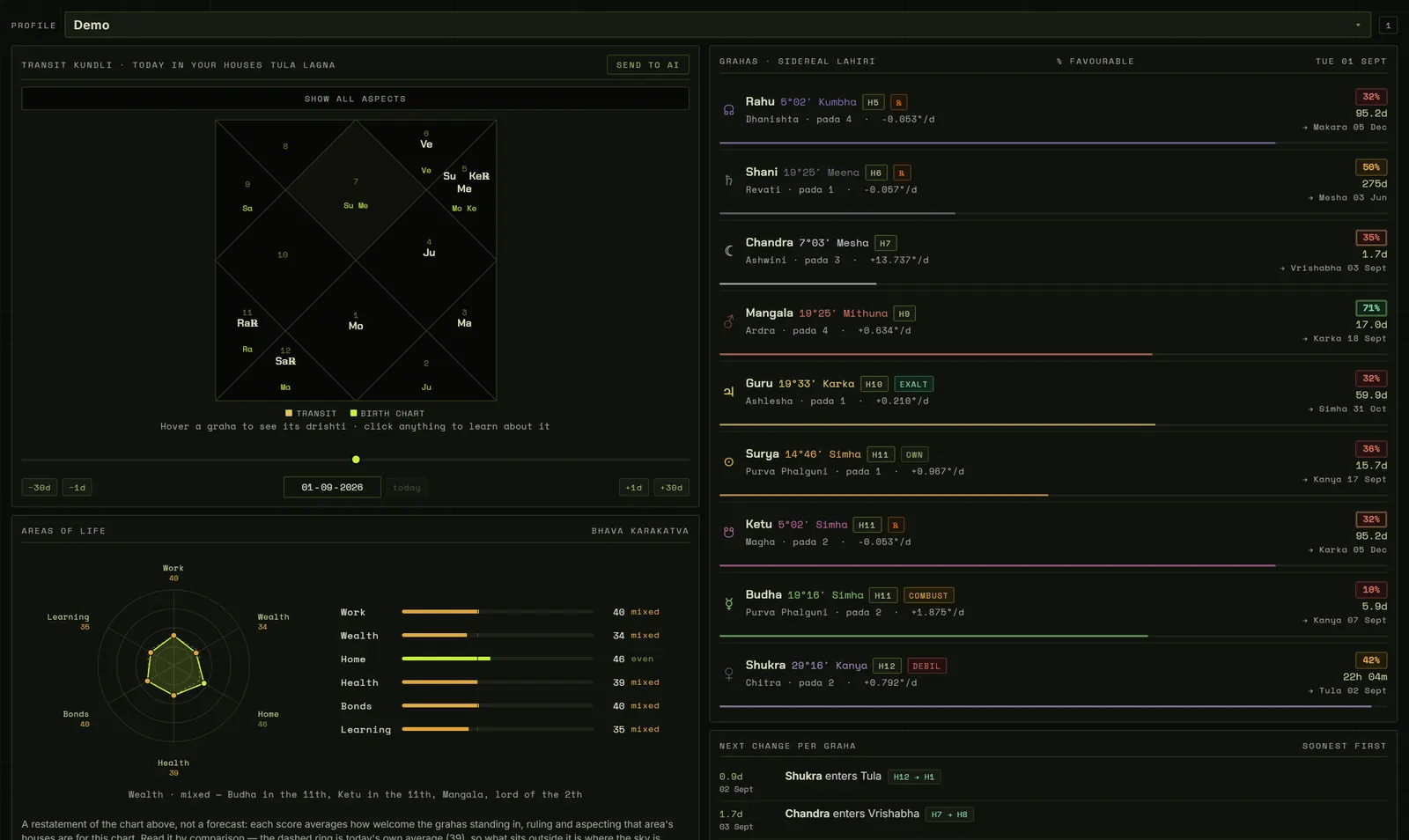
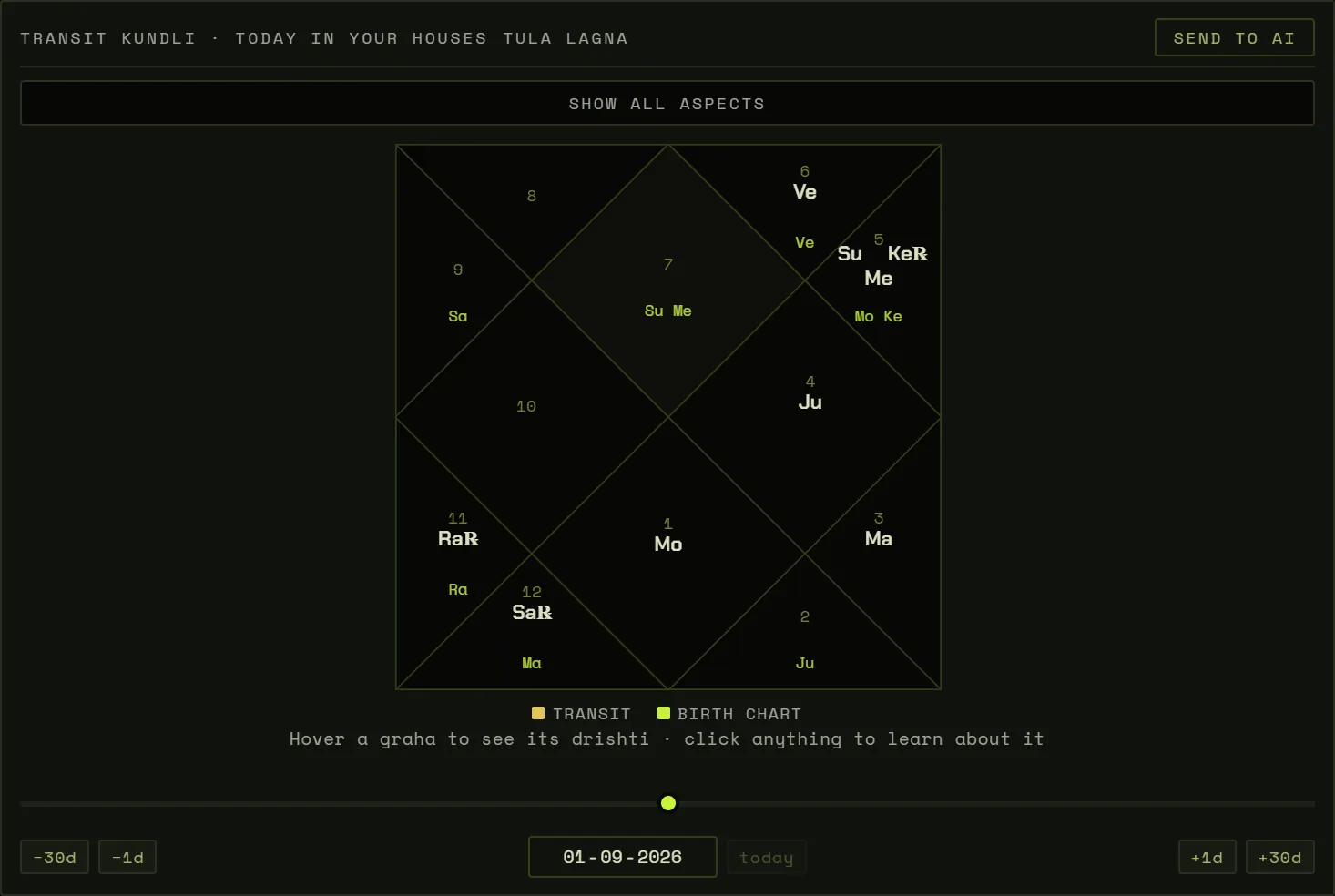
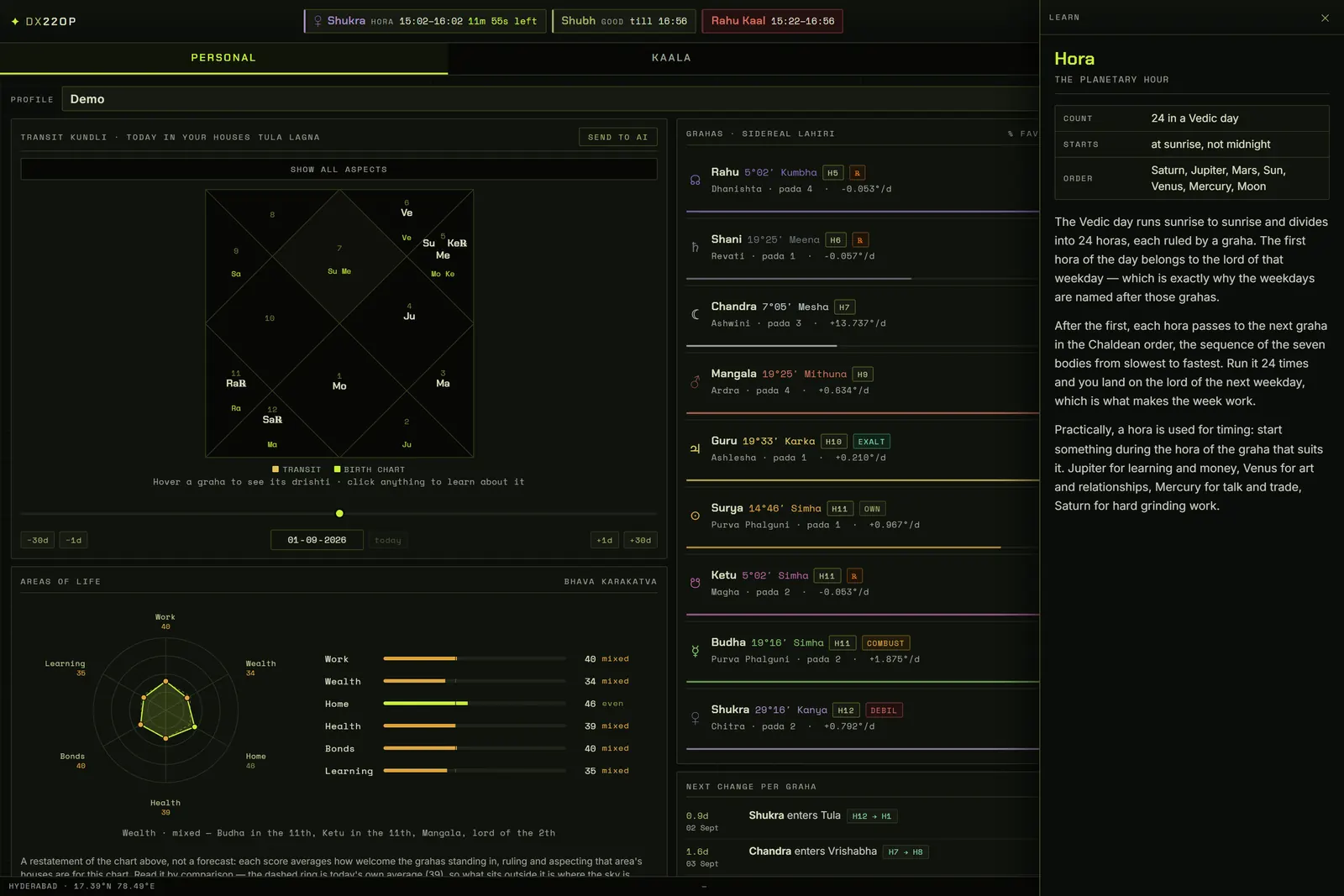
01 — Personal. Today's sky read into one chart's houses, with the birth chart drawn onto the same grid. Captured from the running app.
Overview
Where the sky actually is — right now, from where you are.
DX22OP lives in the tray, and a click drops a panel carrying today's sky read into one person's houses — an interactive transit kundli with the birth chart on the same twelve houses, the running Vimshottari dasha, Sade Sati and Kantaka Shani measured from the natal Moon, and one row per graha for its position, nakshatra, house, condition and the clock to its next rashi. A second tab draws the Vedic day itself: a hora dial that switches to choghadiya or the kaal windows, with the five limbs of the panchang and the exact instant each one ends. Nothing is fetched and nothing is precomputed — the engine runs on your own machine, for your own place, on whatever date it is asked for.
No predictions and no readings — positions, motion and clocks. Everything is computed locally and stays on the device: no account, no upload, and nothing it needs to be online for.
// Specifications
Platforms
Windows · macOS
Ayanamsa
Lahiri (Chitrapaksha) · sidereal
Ephemeris
astronomy-engine · VSOP87 / ELP, no data files
Accuracy
0.42′ worst · 0.15′ mean vs Swiss Ephemeris
Tests
191 assertions, 0 failing
Yogas
49 rules, each with its evidence
Places
232 cities offline · 152 in India
Houses
Whole sign · mean node
Footprint
~0.03% duty cycle · nothing when hidden
Runtime
System webview — no bundled browser
Install
Per-user · no administrator rights
Price
Free
The headline acts
Three things a panchang app usually gets wrong.
Computed, not tabulated
Correct in London — and still correct in 2150.
Panchang elements are quoted at sunrise, and sunrise depends on where you are: a table of tithi end-times baked for Hyderabad is simply wrong in London, and this app lets you change place. So every day is computed from scratch, for your place, in about four milliseconds — right anywhere, and it never runs out. Festivals are rules over tithi and lunar month rather than a list, which is why the suite can assert a day in 2150 at all.
15 published 2026 festival dates asserted · all 15 land on exactly one day
Checked, not asserted
191 assertions against Swiss Ephemeris.
The engine is verified against the Swiss Ephemeris output embedded in the professional reading this app replaces — nine positions at a known epoch, plus twenty-two dated ingresses and stations over the following four months. Worst positional error 0.42 arcmin, mean 0.15. Lahiri is anchored the way Swiss Ephemeris defines it, on the 1956 ICRC value of 23°15′00″, exact to 0.00″ — a polynomial fitted about J2000 looks equivalent and misses that anchor by 33″, dragging every graha with it.
Matches AstroSage's defaults for Indian charts
Drawn honestly
The Vedic day, at its real width.
Kaala opens the day as a ring at sunrise with a hand tracking the moment, and a segmented control changes what the ring divides — 24 horas coloured by their ruling graha, sixteen choghadiya by quality, or the four kaal windows as islands on a quiet band. Arc width is real elapsed time, so the unequal-hora convention draws as it actually falls instead of being flattened into equal slices.
Hora · choghadiya · Rahu, Yamaganda, Gulika and Abhijit
In the field
What you'd use it for.
01
Pick a muhurta: move the whole app to a day — chart, dial, panchang and journal together — and read its horas, choghadiya and kaal windows before committing to it.
02
See where today's sky lands in your own houses, with the birth chart drawn onto the same grid so the fixed and the moving read as two layers of one picture.
03
Find out what a stretch is actually made of: the running dasha with each lord's live rashi and house, and Sade Sati and Kantaka Shani measured from the natal Moon.
04
Know exactly when a graha changes rashi — a countdown for each, and the house change that move produces for this chart.
05
Check what a chart carries: 49 named yogas detected across both the birth chart and today's sky, each showing the rule that fired it.
06
Learn the system while using it — click any graha, house, chip or tag and read what it is in plain language, without leaving the app.
07
Keep notes filed against Vedic time rather than clock time, each slot carrying its hora lord, its choghadiya, and any kaal window it overlaps.
// 02
Capabilities
What's inside.
10 MODULES
01
The transit kundli
North Indian
Whole sign
Two layers
An interactive chart at the top of the Personal tab, carrying today's sky and the birth chart on the same twelve houses.
Transit positions in one colour and natal in another, so what is fixed and what is moving never get confused.
A date scrubber running a year either side of today writes the app-wide selected date — the tables, yogas and header move with the chart instead of drifting out of step.
With a birth chart loaded, scrubbing slides the live sky across your own fixed positions.
02
Drishti — one graha, or all of them
Aspects
Conjunct
Mutual
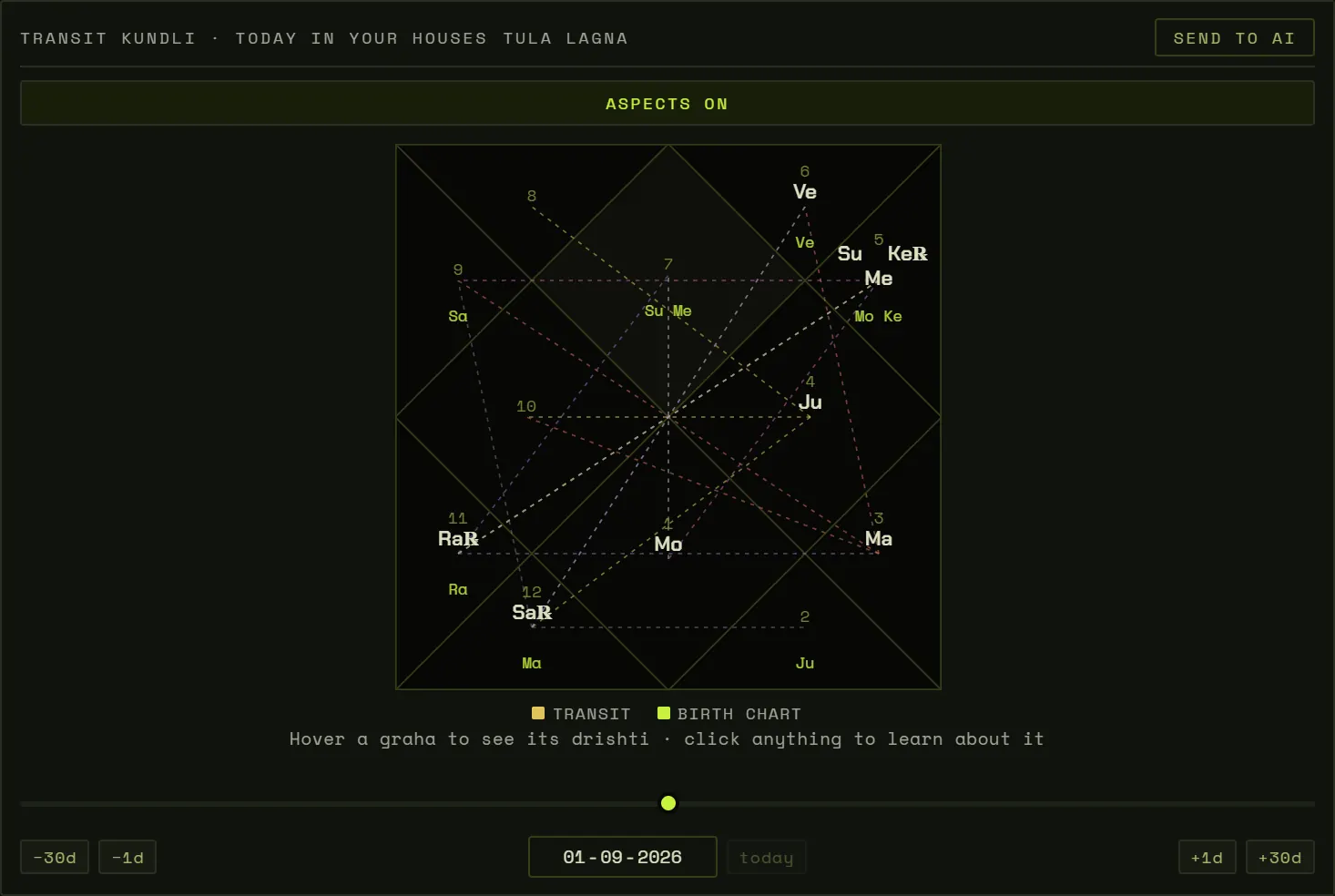
Hover a graha and its drishti lights up. A toggle pins every graha's aspects on screen at once.
Rays out to every rashi it aspects, those houses lit, the grahas standing in them marked as aspected, anything sharing its house marked as conjunct, and anything aspecting it back marked as mutual.
Everything else recedes so the pattern reads.
Hovering answers what does this one touch; the toggle answers where is the pressure — each ray drawn in its source graha's colour.
03
The graha table
Nakshatra · pada
Dignity
Next rashi
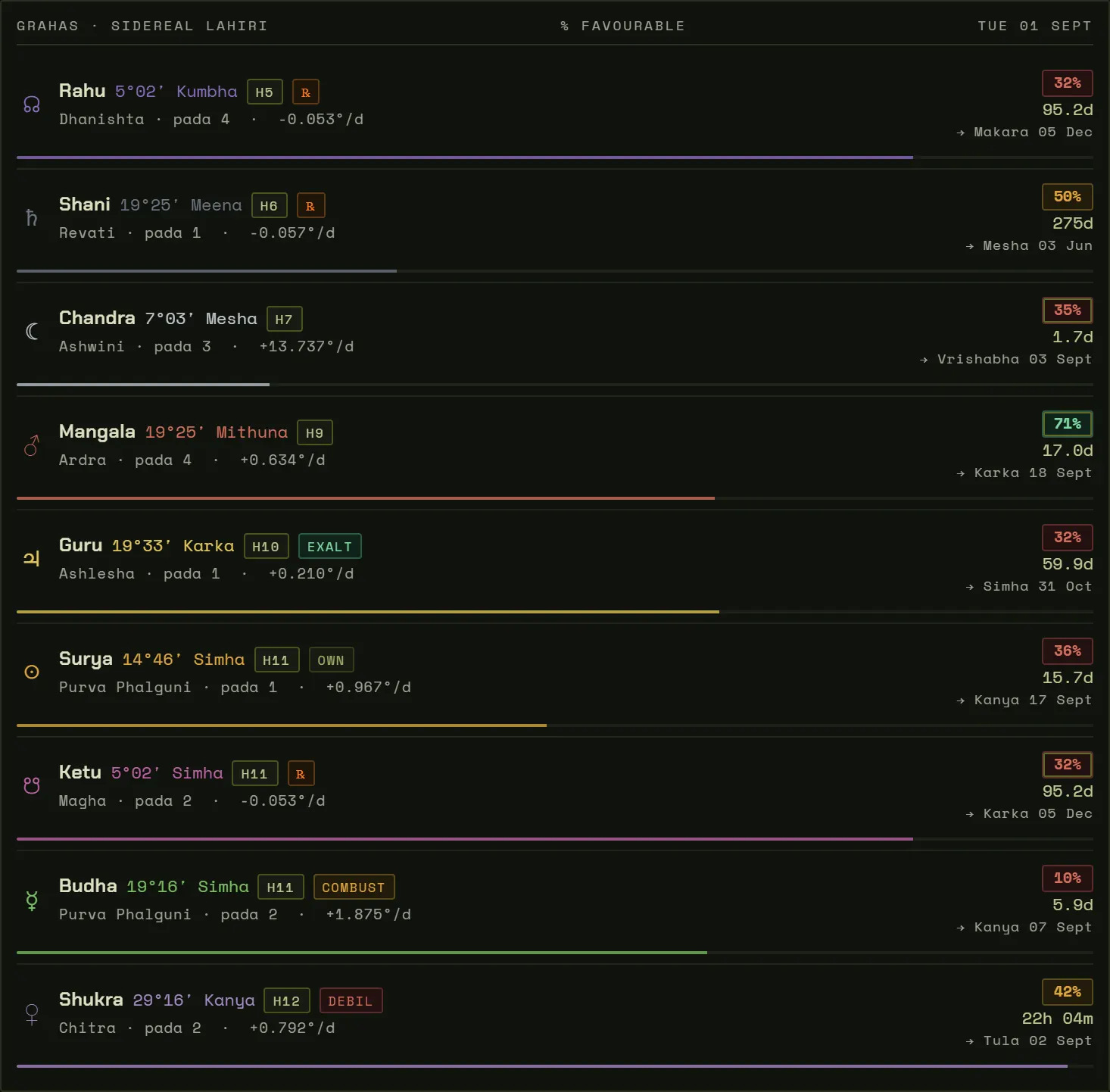
One merged row per graha: where it is, what it is doing, and how long you have.
Sidereal position, nakshatra and pada, the house it falls in for this chart, daily motion, and condition — retrograde, combust, exalted, debilitated.
A clock to the next rashi for each, and a separate list ordered soonest-first showing the house change that move produces.
A % favourable per graha, built from four classical inputs — Gochara from the natal Moon, lordship for that lagna, dignity, and condition. Hover a score to see every contribution behind it.
04
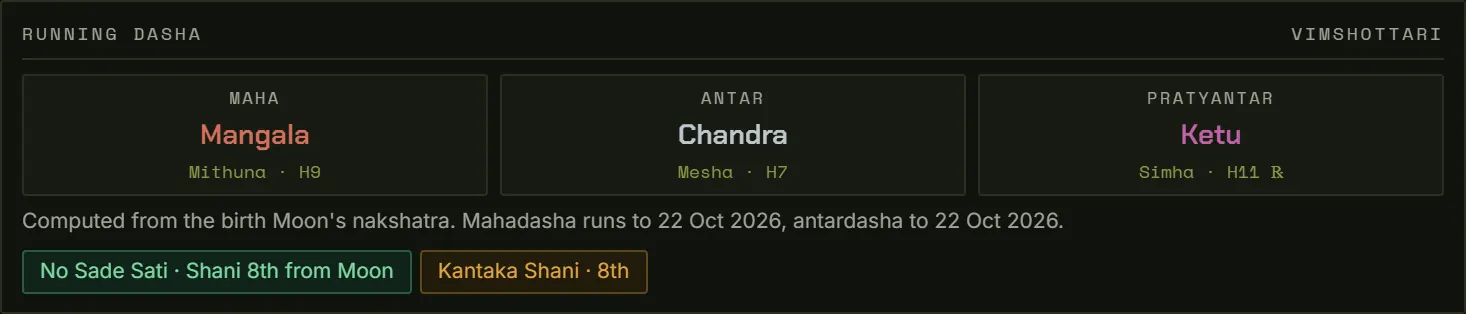
Running dasha, Sade Sati, Kantaka Shani
Vimshottari
Three levels
The period you are actually in, derived from the chart rather than carried as a stated value.
Maha, antar and pratyantar, each lord shown with its live rashi and house.
Computed from the birth Moon's nakshatra, so nothing here can go stale against the chart it came from.
Sade Sati and Kantaka Shani measured from the natal Moon — and named just as clearly when they are not running.
05
Areas of life
Bhava karakatva
Stated model
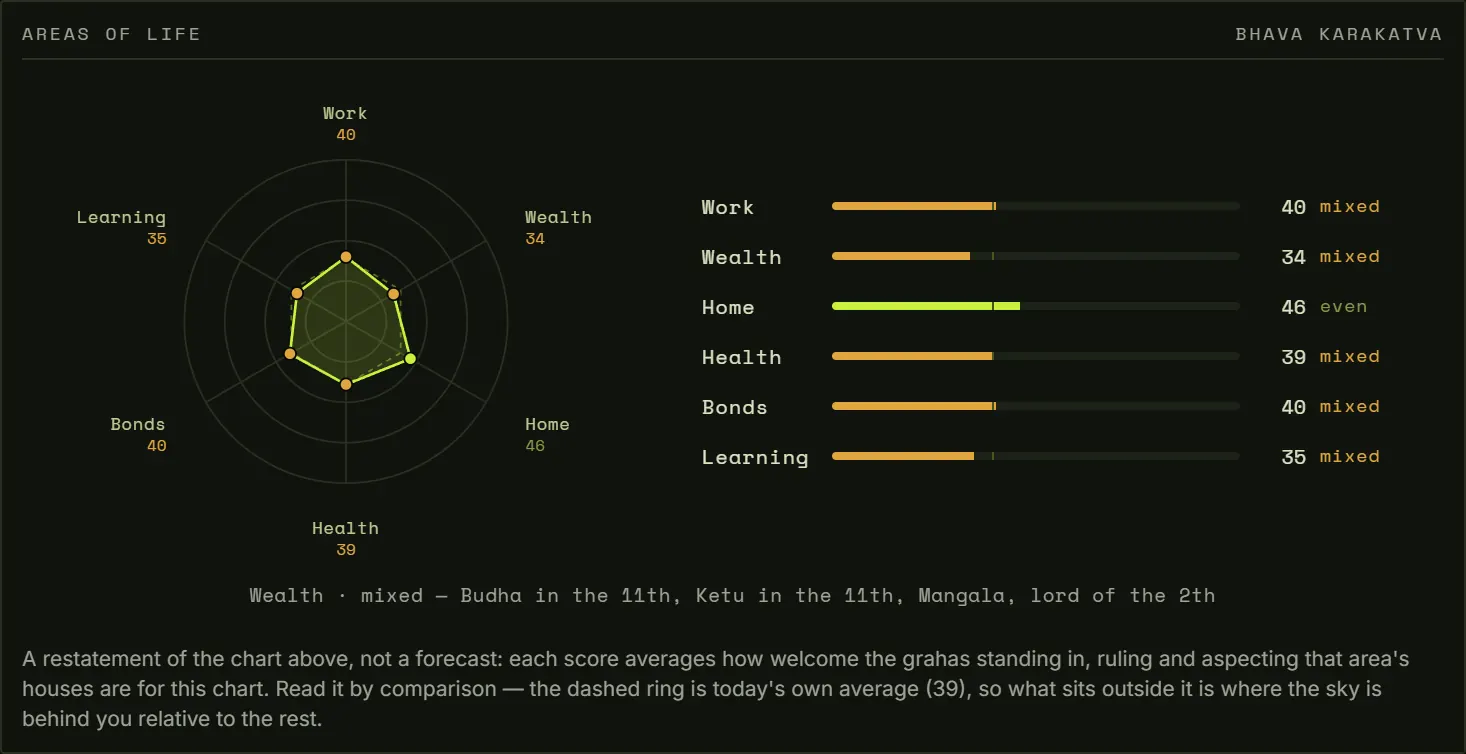
A restatement of the chart above, not a forecast.
Six areas scored by averaging how welcome the grahas standing in, ruling and aspecting each area's houses are for this chart.
Read by comparison: the dashed ring is the day's own average, so what sits outside it is where the sky is leaning.
Vedha is deliberately excluded — the tables disagree, and a number that quietly averages disagreeing sources is worse than one that says what it left out.
06
Yogas, with the evidence
49 rules
Both charts
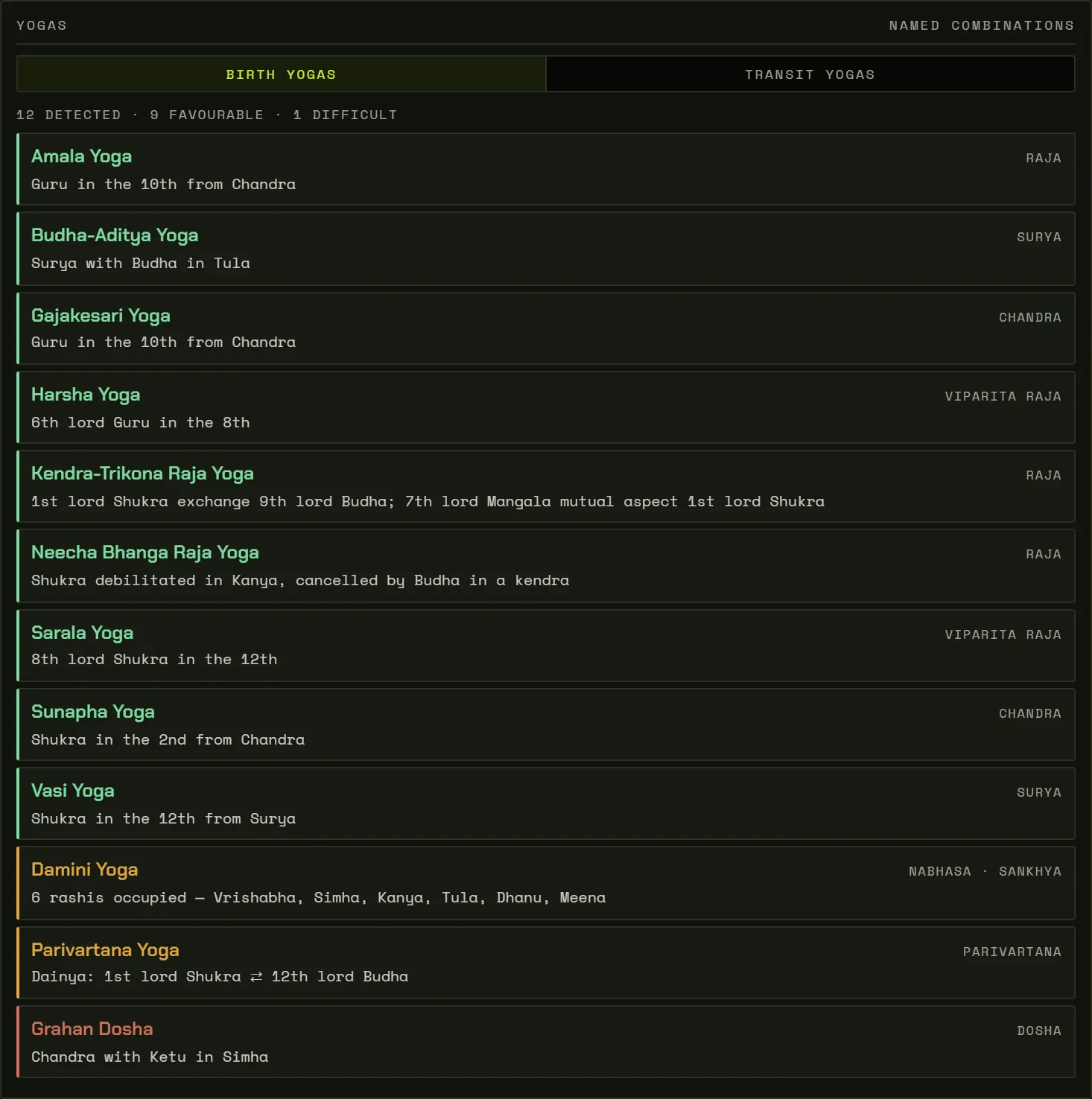
The named combinations the classical texts singled out — detected, and shown with what fired them.
The five Pancha Mahapurusha, the Chandra and Surya groups, Raja and Dhana yogas, the three Viparita Raja yogas, Parivartana exchanges classified Maha / Dainya / Khala, the doshas, and the Nabhasa Sankhya and Aakriti shapes.
Only yogas with an unambiguous, testable definition are included; anything resting on divisional charts, shadbala or the reader's discretion is deliberately absent.
Where sources disagree, the rule actually used is written into the entry — so a detection claims exactly one stated condition and no more.
07
Kaala — the dial, the panchang, the calendar
Hora
Choghadiya
Muhurta
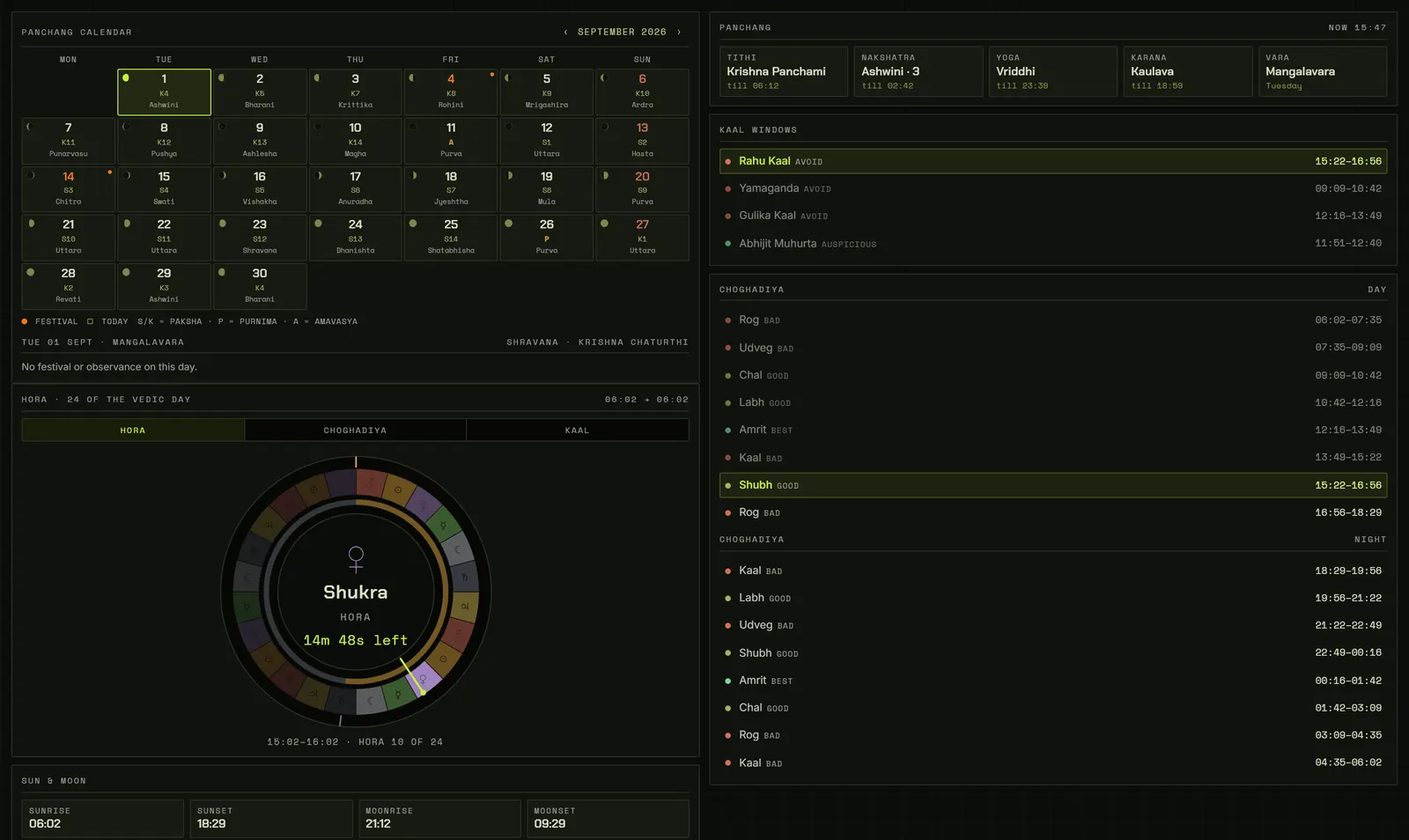
The Vedic day as a ring, with everything that dates it sitting around the outside.
The five limbs of the panchang each with the instant it ends, sunrise and sunset, moonrise and moonset.
Rahu Kaal, Yamaganda and Gulika, Abhijit muhurta, and all sixteen choghadiya — and where a bad window overlaps Abhijit, the bad one is the one shown.
A month grid where every cell carries that day's tithi, nakshatra and festivals rather than just a number; picking a day moves the whole app to it.
08
The learning panel
~50 entries
Opens beside
Click a graha, a house, a chip like combust or ℞, a dasha box or a Sade Sati tag, and it explains itself.
The panel opens beside the app in its own window, so whatever you clicked stays on screen while you read about it.
Plain language: what the thing is, the few facts worth memorising, and why it matters where you found it.
No predictions anywhere in it — the entries describe the system, they do not read your chart back to you.
09
Journal
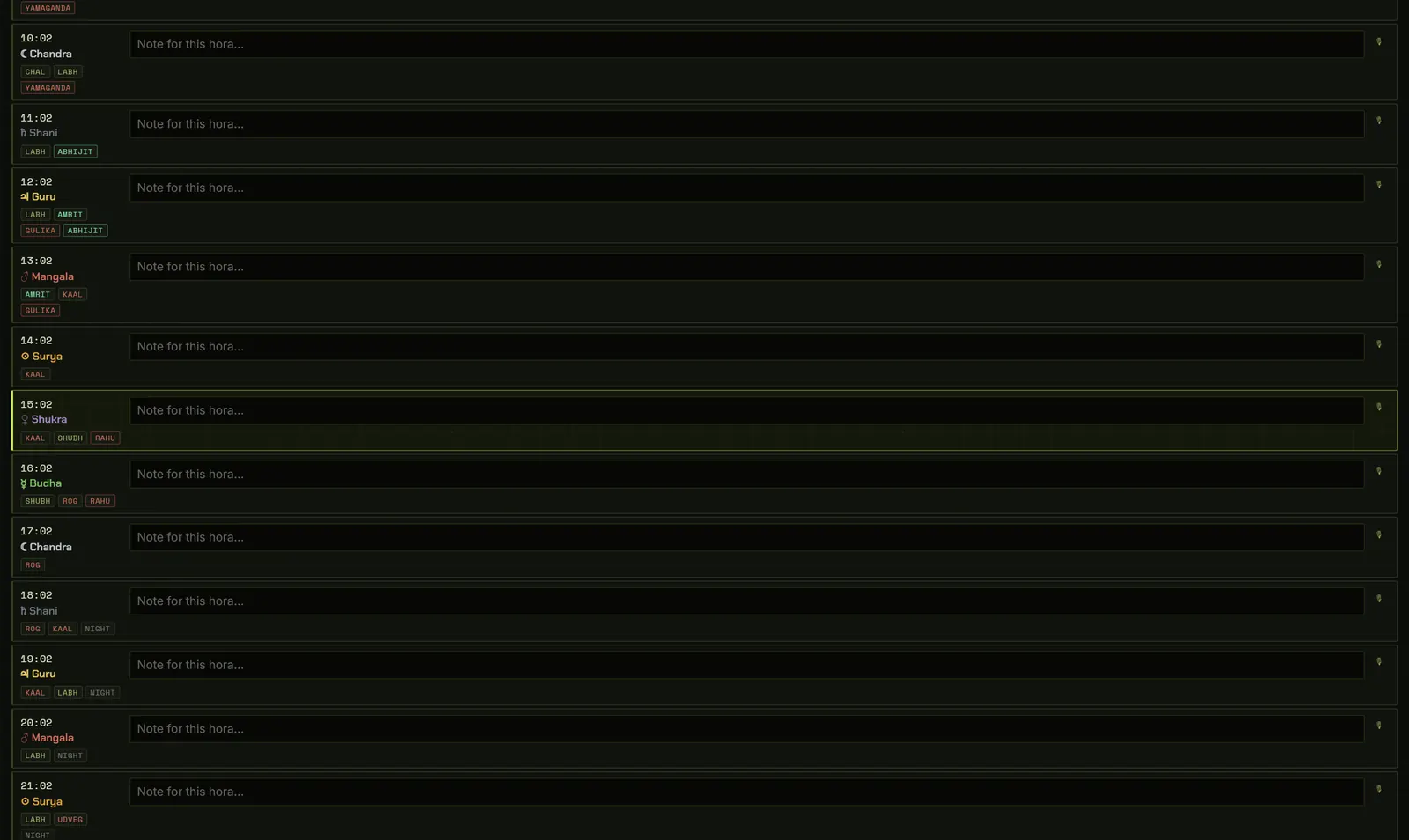
Filed by hora
The day laid out as its twenty-four horas, so a note lands on Vedic time rather than clock time.
Each slot carries its hora lord, the choghadiya running inside it, and any kaal window it overlaps.
Type, or dictate where the webview provides a speech engine.
Kept on the device with everything else — there is nowhere for it to go.
10
Where you are, and whose chart
232 cities
Works offline
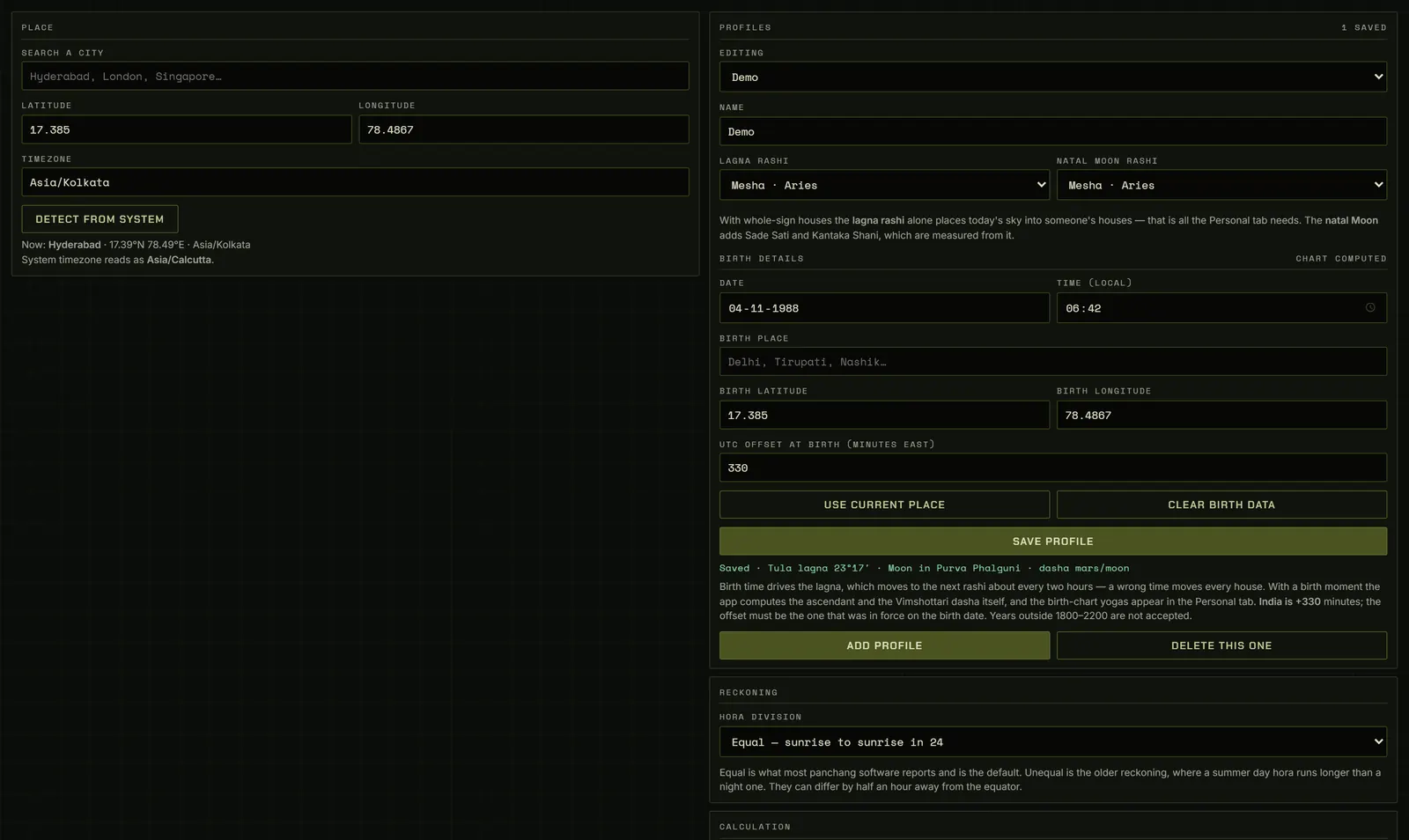
Setup asks for surprisingly little, and asks for none of it over a network.
With whole-sign houses the lagna rashi alone places every transiting graha, so that single field makes the entire Personal tab work.
Add a birth date, time and place and it stops needing even that: it computes the ascendant, derives the dasha from the birth Moon's nakshatra, and detects the birth-chart yogas itself.
Places search an offline table of 232 cities, 152 of them in India, because a birth place is far more often a district town than a metro. Where the table does not reach, type the coordinates.
Get it
The desktop app is live.
Windows 10 / 11 · 64-bit · 4.6 MB · free. No account, and nothing to sign up for.
Platform
Windows 10 / 11 · 64-bit
Size
4.6 MB
Version
v1.0
Price
Free
A per-user install: no administrator rights, and nothing written outside your own profile. It upgrades an existing copy in place rather than leaving an orphan beside it.
// SHA-256
af9846a954303e22802590533045c6780d3ea4cdd7eeffeb9687889bf79b4398
In build
A full mobile app is in build. The macOS desktop build follows it.
// Issued Class
Oscar Papa Class
DX22OP is commissioned under the Oscar Papa Class — part of the PAR2 LABS product divisions, each marked by its own issued crest.