All Resources
R-46
Film Making
How Character Sheets Hold an AI Ensemble Together
One character survives a good prompt. Fifteen do not. What it takes to keep a whole cast recognisable across four locations and a minute of generated film.
PAR2 Labs
September 18, 2026
9 min
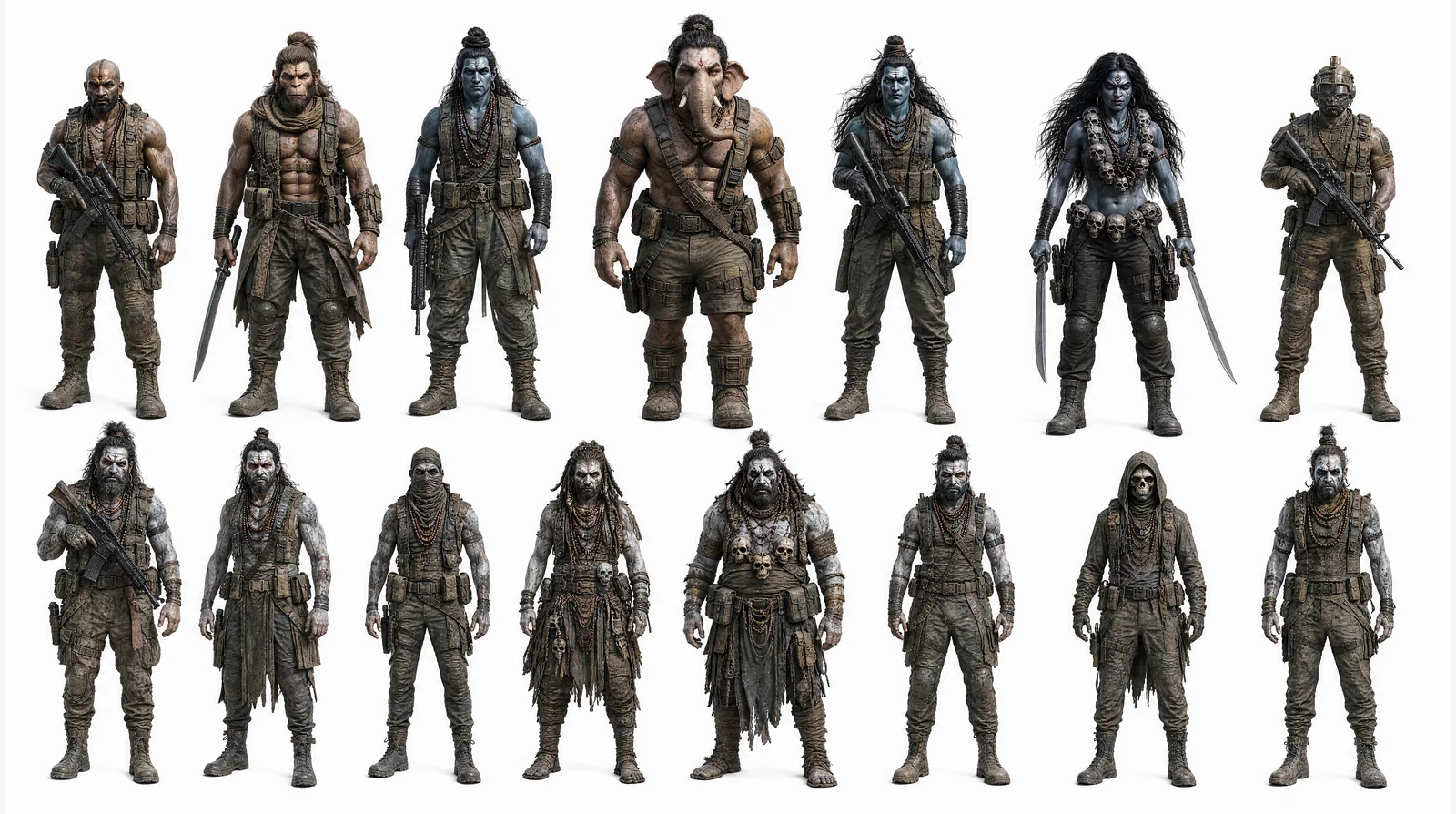
Generated video forgets faces. Not dramatically — it drifts: a jaw narrows, an eye colour moves half a shade, a scar changes side, and by the third shot the audience is looking at someone else's brother. With one character you can prompt around it. With fifteen sharing frames you cannot, because the model starts averaging them into each other. Ganapathi is a one-minute film with fifteen designed characters across four locations, and this is the method that held it together.
01
The failure mode nobody warns you about
Ask a model for "a weathered warrior with an elephant's head, olive webbing, a topknot" and you will get one. Ask again for the next shot and you will get a different one — same description, different person. The description is a region of possibility, not a point in it, and every generation samples somewhere new inside that region.
With a single lead this is survivable. You generate, you compare, you throw away the takes where the face moved, and you pay for the extra takes. With an ensemble it stops being survivable, for a reason that is specific rather than general: once two characters described in similar language appear in the same frame, the model does not keep them apart. It blends them. The scarred soldier picks up the ascetic's beads; the ascetic inherits the soldier's jaw.
So the problem is not "AI is inconsistent". The problem is that a text prompt is the wrong instrument for identity, the same way a paragraph is the wrong instrument for blocking.
02
What we did instead
Ganapathi has fifteen designed characters — gods, an ash-covered war band, modern soldiers, and a handful of civilians in a laboratory — across a temple at night, that laboratory, a Himalayan ridge at dawn, and a valley full of running figures. Nothing about that is a scene you can stage once and shoot from fourteen angles, which is what the previous film in this series did.
So the first artefact was not a previz. It was the cast.
| Artefact | What it fixes | When it is made |
|---|---|---|
| Turnaround sheet, per principal | The character's geometry: head shape, build, silhouette | Before any shot is generated |
| Line-up sheet, whole ensemble | The cast relative to each other — height, bulk, palette | Before any shot is generated |
| Environment plates | Light, ground, weather, wreckage | Per location |
| The shot | Camera and action only | Last |
03
Four views, not three
A turnaround is front, three-quarter, profile and back. It is tempting to cut the back view — it is the one nobody looks at, and it is the one the model is least confident about. Cut it and you will find out why it matters the first time a character walks away from camera: the back of a head is where the model has the most freedom and the least supervision, so it invents, and the invention does not match the invention it made in the previous shot.
The three-quarter view is the one doing the most work. Most shots in most films are three-quarter. If the sheet only has front and profile, the model interpolates between them, and interpolation is exactly the drift you were trying to remove.
Two versions of each sheet are worth having: one lit the way the film is lit, and one on a plain ground. The lit sheet carries mood and material. The plain one carries shape without argument, and it is the one that behaves best as reference, because there is no environment in it for the model to copy by accident.
Describe a character and you get a different person every shot. Show the model the character and you get the character.
04
The line-up is the reference, not the prose
The single highest-leverage artefact is the one that holds the whole cast on one plain background at one scale. It does something no per-character sheet can: it fixes the ensemble relative to itself. Who is the tallest. Who is the heaviest. Which two are nearly the same silhouette and therefore need to differ somewhere obvious — a hood, a weapon, a colour.
It is also the answer to the blending problem. When the reference contains all fifteen at once, distinguishing them is part of what is being referenced rather than something the model has to infer from adjectives.
05
How to know whether it worked
The test is not to generate the same shot twice. That proves the seed is stable and nothing else. The test is to change everything except the cast.
For this film that meant generating the same advancing line twice: once through bombed-out ruins under dust and a grey sky, once through snow in the high passes under a clear one. Different ground, different light, different colour temperature, different atmosphere. If identity is really held by the sheets, the faces survive the change. If it was being held by the environment description, they will not.
They survived. That pair of frames is the only evidence in the whole case study worth arguing from, which is why both are published on it.
06
What this does not fix
Sheets hold identity. They do not hold blocking, and they do not hold the camera. A film staged this way still wanders shot to shot unless something else decides where the camera goes — which is what a greybox previz is for, and the two techniques are complementary rather than alternatives.
They also do not hold performance. Where a scene turns on a look between two people, reference gets you the right two faces and nothing about what passes between them.
And they cost design time up front, at the point in a project where nobody feels like spending it. That is the trade: hours in a sheet before a frame exists, against re-generating shots that keep coming back subtly wrong and a cut that never quite settles.
07
The short version
Describe a character and you are sampling from a description. Show the model the character and you are referencing a design. For one lead the difference is money. For fifteen it is the difference between a film and a collection of shots that happen to share a theme.
Key Takeaways
01
Design the cast before the camera — a turnaround sheet is cheaper than a re-generated shot.
02
Four views per principal: front, three-quarter, profile, back. Three is not enough for a character who turns.
03
Put the whole ensemble on one line-up sheet against a plain ground; that sheet, not a paragraph, is the reference.
04
Test identity by changing everything else — same cast, different environment, different light.
PAR2 Labs · Film Making
Work With Us