All Resources
R-44
Film Making
Minimum Viable Budget: Costing a Film Backwards From What It Can Actually Return
Most films are budgeted forward from what the producer can raise and costed backwards never. Invert it — derive the budget the script must fit from the recoupment waterfall, then hold the production to it through six gates. With the arithmetic left in.
PAR2 Labs
August 30, 2026
16 min
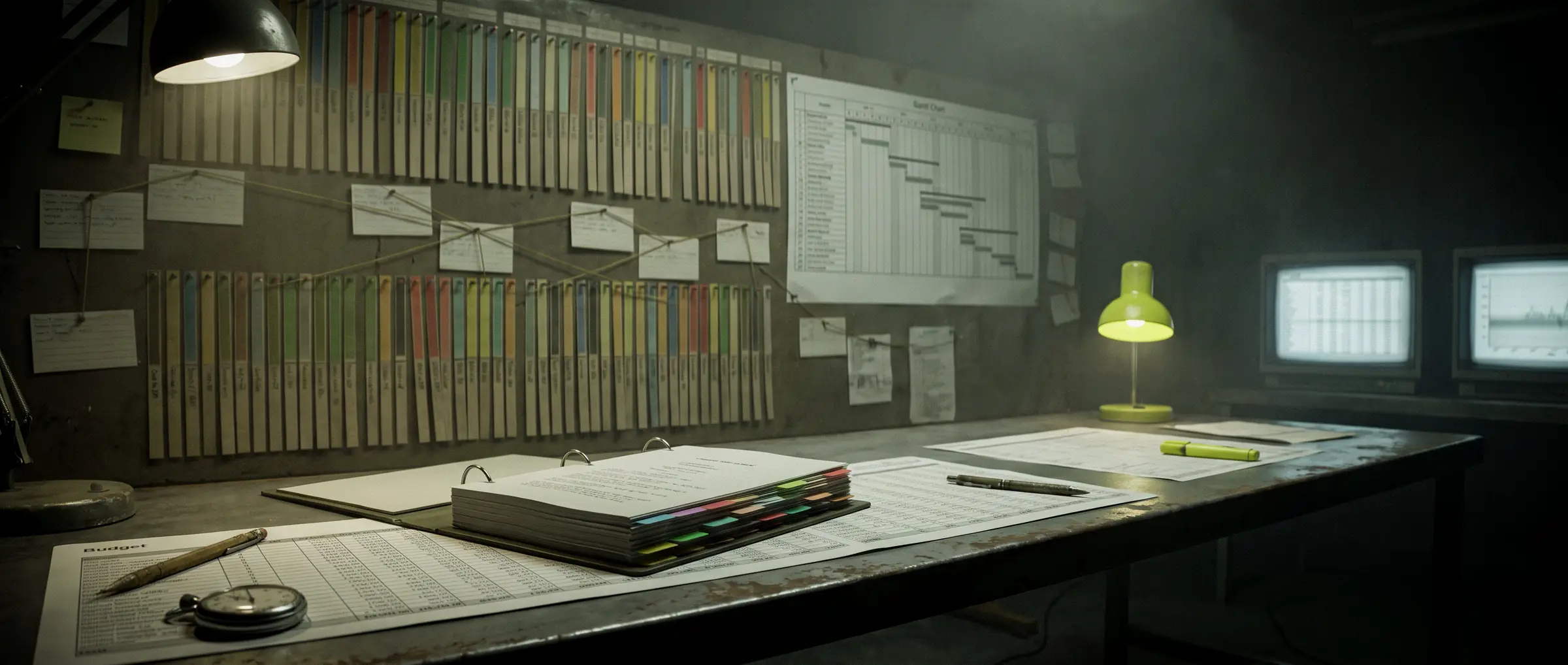
A film budget is a prediction, and almost nobody treats it like one. The number is set from what can be raised rather than from what the film can return, the script is never costed against it line by line, and every change after that is agreed in a corridor and priced at wrap. This is how we do it instead: a script audit with a probability band rather than a verdict, a minimum viable budget derived backwards from the recoupment waterfall, and six approval gates carrying the same stage-gate and sprint discipline that IT delivery has run on for thirty years. The worked example at the centre takes an ₹18 crore plan down to a ₹7.3 crore film that tells exactly the same story.
Watch the explainer
5:08
Narrated, with every diagram built on screen: two ways to a number, a worked example, costing the script and six gates.
01
The failure is not creative. It is a decision process.
India releases more feature films than any country on earth — 1,769 of them in 2022 alone — and in a representative recent year only about forty per cent of releases were profitable. That is not a talent shortage. India does not have a shortage of people who can direct, shoot, cut or perform. What it has is a shortage of the boring apparatus that any other capital-intensive industry treats as non-negotiable: a costed plan, a baseline, a change-control log, and someone whose job is to say the number out loud before the money is spent rather than after.
The overrun data says the same thing everywhere the industry has been measured. Studio productions run roughly thirty-one per cent over budget on average; independents run closer to forty. In 2022, seventy-two per cent of films budgeted above one hundred million dollars went over. The industry has known this long enough to have built a financial instrument specifically to price the risk — the completion bond, typically a fee of around two per cent of the budget on top of a mandatory contingency of about ten per cent of direct costs. That is the market's own estimate of how likely a film is to miss its plan. Twelve per cent, in cash, before a frame is shot.
None of that is a criticism of producers. It is a description of a gap. A production house is organised to make films. It is very rarely organised to run a capital programme, and a film is a capital programme wearing a beret.
02
Two ways to arrive at a budget, and only one of them is a plan
Almost every film budget in the world is built forward. Someone establishes what can be raised — a slate commitment, a satellite pre-sale, a distributor's advance, a family office — and that figure becomes the budget. The script is then made to fit it, roughly, by a line producer working from a page count and experience. The number that never gets calculated is the one that matters: what the film has to earn before a rupee comes back, and whether anything comparable has ever earned it.
Costing backwards inverts the whole exercise. You start from the realistic gross floor of the film's own comparable set, run the recoupment waterfall down to what the producer actually receives, and the result is a ceiling. That ceiling is the Minimum Viable Budget: the all-in negative cost at which the film still returns capital if it performs at the low end of its band, not the high end. Every rupee above it is a bet that this film outperforms every comparable it has.
The direction of the arithmetic is the entire argument. Forward, the budget is an input and the return is a hope. Backward, the return is the input and the budget is a constraint — which is the only form in which a budget can actually be defended in a room.
Fig 1 — the same film, two arithmetics. Forward budgeting makes the return a hope. Backward costing makes it the input, and the budget the thing that has to give.
03
Why the industry rule of thumb under-states it for an independent
The standing rule is that a film needs a gross of roughly two to two and a half times its production budget before it breaks even. The reasoning is sound as far as it goes: the exhibitor keeps around half of net box office, and prints-and-advertising has historically added about half the production budget again on top.
But that rule was formed in a studio context where the studio is also the distributor. Drop an independent Indian producer into the same waterfall and two more lines appear. Admissions carry GST before anything is shared. And a distributor who is not you takes a commission on the distributor's share, typically fifteen to twenty per cent, and recovers P&A off the top before anything reaches the producer. Run those in and the multiple for an independent lands closer to three times, not two and a half.
This is exactly why the rule of thumb is a starting point rather than an answer. It gets you into the right postcode. The actual figure comes from writing that specific film's waterfall out, with its own tax treatment, its own distribution terms, its own P&A commitment and its own cost of money — which takes an afternoon and is almost never done.
04
A worked example, with the numbers left in
What follows is a worked example rather than a client engagement — the structure is the one we run, the rates are published industry averages, and every figure is shown so the arithmetic can be argued with. A mid-budget Hindi-language thriller. One recognisable lead at a defined star tier. A planned wide release. The producer arrives with a settled intention: eighteen crore.
Gate 0 starts with comparables, not with the script. Same genre, same language, same star tier, same release window, last five years, all-India theatrical. That set brackets a realistic gross band of ₹22 to ₹34 crore, with a median of ₹27 crore. We plan against the floor of the band — ₹22 crore — because a budget defended by the median is a budget that fails half the time.
| Line | Basis | ₹ crore |
|---|---|---|
| All-India theatrical gross | comparable floor | 22.00 |
| less GST on admissions | ≈15% of gross | (3.30) |
| Net box office | 18.70 | |
| less exhibitor share | 50% of net | (9.35) |
| Distributor share | 9.35 | |
| less distributor commission | 20% | (1.87) |
| less P&A recovered off the top | agreed spend | (3.00) |
| Producer's theatrical return | 4.48 | |
| plus digital / OTT | licence | 3.20 |
| plus satellite | licence | 1.60 |
| plus music & ancillary | 0.35 | |
| Total producer recovery | at the band floor | 9.63 |
← Swipe for the rest of the table →
← Drag for the rest of the table →
Rates are indicative published averages, not a quotation. The point of the table is that it exists at all — this is the number the film has to beat, and on most productions nobody has written it down.
So at the floor of its own comparable band, this film returns ₹9.63 crore to the producer. That is the break-even ceiling for all-in negative cost. Ask for a twenty per cent return on capital instead of bare recovery and the ceiling falls to ₹8.03 crore. Inside that sits a governed contingency at ten per cent and the cost of finance and completion cover at roughly four per cent, which back-solves to a production budget of about ₹7.0 crore.
Now run the producer's ₹18 crore through the same waterfall in the other direction. All-in it becomes ₹20.6 crore. A film at that level carries a larger P&A commitment and better non-theatrical licences — call it ₹5.0 crore of P&A and ₹5.6 crore of digital, satellite and music. To return ₹20.6 crore the film needs a theatrical return of ₹15.0 crore, which needs a distributor share of ₹25 crore, which needs net box office of ₹50 crore, which needs an all-India gross of roughly ₹59 crore.
Nothing in its comparable set had ever cleared ₹34 crore.
That single sentence is the entire value of Gate 0. It costs a fortnight and it is available before a location is scouted, a date is promised, or a rupee of anyone's money is at risk. It is not a creative judgement and it is not a prediction that the film will fail — it is the observation that the plan as drawn requires an outcome with no precedent in its own category, and that the producer should either accept that as a deliberate bet or change the plan.
The three numbers on one line
01
Minimum Viable Budget — production budget of ₹7.0 crore, all-in ₹8.03 crore, returns 20% at the band floor.
02
Break-even budget — production budget of ₹8.42 crore, all-in ₹9.63 crore, returns capital and nothing else at the band floor.
03
The plan as presented — ₹18 crore production budget, all-in ₹20.6 crore, requires ₹59 crore of gross. Category record: ₹34 crore.
05
Gate 1 — what does the script cost, as written?
The MVB is a ceiling, not a budget. The next question is what the script actually costs, and it is answered scene by scene rather than by page count. Every scene gets a unit, a location class, a cast day-out-of-days entry, a stunt or crowd flag, and a VFX methodology — not a VFX line, a methodology, because 'we'll fix it in post' is not a method and it is where the money goes.
Costed that way, this script comes to ₹11.4 crore. Not the ₹18 crore that was going to be spent, and not the ₹7.0 crore that can be recovered. The gap is entirely legible once it is broken out.
| Driver | ₹ crore | What is actually in it |
|---|---|---|
| 47 VFX / CG shots | 2.60 | 31 carry no agreed methodology — placeholders deferred to post |
| 3 crowd days across 2 cities | 1.90 | ≈900 junior artists, two permits, two unit moves |
| 46-day schedule, 9 company moves | 1.40 | 6 of the moves buy nothing the audience can see |
| 11 practical night exteriors | 0.95 | lighting package, generators, overtime, turnaround |
| Remaining production | 4.55 | cast, crew, equipment, post, insurance, overhead |
| Script as written | 11.40 | against an MVB ceiling of 7.00 |
← Swipe for the rest of the table →
← Drag for the rest of the table →
Four drivers carry ₹6.85 crore between them, and none of the four is the story. That distinction is the whole of the consultancy: we are not asking the writer to cut the film. We are asking which of these four decisions the audience can actually see, and re-blocking the ones they cannot.
A budget the film cannot earn back is not a budget. It is a schedule attached to a loss.
06
The rewrite is creative work, done for commercial reasons
Consolidating two cities into one removes six company moves and four shooting days without touching a single line of dialogue — the second city was a location note, not a dramatic requirement. The crowd sequence plays identically with a controlled unit of 120 and generative crowd extension on three wide shots; nobody in the room can tell, because the coverage was always close.
The VFX pass is the largest single change and the one that most needs technical people in the room while the shooting script is still soft. Of 47 shots, 18 are achievable in camera once the blocking is adjusted, and 13 more can be built as 2.5D from generative plates using a reconstructed depth and matte stack rather than a full CG rebuild. That leaves 16 genuine VFX shots with an agreed methodology and a named vendor, budgeted rather than deferred.
Night exteriors drop from eleven to six by moving two sequences to dusk-for-night, which the cinematographer had already suggested and which had never been costed as a saving.
The film lands at a 38-day schedule, three company moves, and ₹7.3 crore of production budget with ₹0.73 crore of governed contingency — ₹8.03 crore all-in. Inside the MVB, with the twenty per cent return band intact, telling the same story with the same beats and the same ending.
Where the VFX re-blocking actually comes from
Rebuilding the layer stack from flat footage
The depth, normals, flow and matte reconstruction that makes 2.5D set extension a budget line rather than a full CG rebuild.
The CG-first pipeline, twelve stages
Which shots belong in the render lane and which in the generation lane — the call that fixes post's cost in prep.
07
Why the discipline comes from software, and where the analogy stops
Barry Boehm published the observation in 1981 and it has survived four decades of argument: the cost of correcting a mistake rises steeply the later it is found. Requirements, design, code, test, production — each step costs meaningfully more than the last. Boehm and Basili's later work put the ratio at around a hundred to one between requirements and post-delivery on large systems, and around five to one on small ones.
It is worth being precise about what is durable there, because the figure gets quoted more confidently than the underlying data supports. The reliable claim is the shape of the curve, not a specific multiplier. But the shape is enough, and film has a steeper version of the same curve than software ever did. A structural note on a screenplay costs a fortnight of a writer's time. The same note after the unit has wrapped costs a reshoot, a cast availability window, a location that has changed season, and a delivery date that has already been sold.
Where the analogy stops matters too, and we say so to producers before they ask. Software can ship an increment and learn from it; a film cannot release act two and iterate. So we do not run film production as Scrum. We run stage gates for the irreversible decisions — script, budget, schedule, cast, methodology — and sprint cadence only inside a gate, where prep tasks, VFX shots and post deliverables genuinely can be planned, burned down and re-forecast weekly. Gates for the things you cannot take back. Sprints for the things you can.
Fig 2 — the gates carry the irreversible decisions. Sprint cadence runs inside G2 through G4, where re-forecasting weekly is genuinely possible.
08
The six gates, in detail
A gate is not a meeting. It is an artefact, an approval and a decision recorded with its reasoning, so that six months later the question 'why did we agree to this' has a written answer rather than four conflicting memories.
G0
Feasibility
TOOL
Script audit · comparables · return model
USE
Deciding whether this film should be made at this scale at all
GET
Greenlight memo: go, rework or no-go, with reasoning attached
Audit the screenplay for structure, act timing, character pressure and scene economy. Build the comparable set — genre, language, star tier, window — and derive the realistic gross band. Model the return against that band rather than against the best case. State the structural weaknesses by name and the probability band by number.
Why: This is the only gate where 'no' is cheap. Every later no costs a development slate, a cast hold, or a deposit on a stage.
G1
Minimum Viable Budget
TOOL
Recoupment waterfall · scene-level costing · VFX grading
USE
Fixing the ceiling, then costing the script against it
GET
MVB, the waterfall, three budget scenarios, and a prioritised list of cost drivers
Run the waterfall down to producer recovery at the band floor. Cost the shooting script scene by scene with a unit, a location class, a day-out-of-days entry and a VFX methodology per shot. Rank the drivers of the gap by rupees, not by page count. Propose re-blocking rather than cuts wherever the audience cannot see the difference.
Why: A budget the film cannot earn back is not a budget, it is a schedule attached to a loss. And the drivers are almost never the story — they are logistics decisions nobody priced.
G2
Plan lock
TOOL
Stripboard · sprint plan · risk register · deliverables matrix
USE
Turning the agreed film into a baseline everything is measured against
GET
Signed baseline: schedule, budget, contingency policy, risk register, delivery matrix
Build the stripboard from the audited script — company moves, unit days, cast day-out-of-days. Plan prep and post as sprints with a definition of done per deliverable. Register every risk with an owner, an impact and a trigger. Write the contingency policy: what it may be drawn for, who approves, and against which registered risk.
Why: Without a signed baseline there is nothing to have a variance against, and 'over budget' becomes an opinion rather than a measurement.
G3
Production control
TOOL
Variance reporting · change control · earned value
USE
Running the shoot against the baseline rather than against memory
GET
A one-page weekly control report; a change log with a price against every line
Track planned versus earned versus actual — scenes completed against scenes scheduled, not just days elapsed against days budgeted. Price every proposed deviation before it is agreed and route it to a named approver. Re-forecast to completion weekly rather than reporting spend to date.
Why: Days elapsed tells you nothing. A unit can be on schedule and twelve scenes behind. Earned value catches that in week two instead of week six.
G4
Post and finishing
TOOL
Shot burn-down · vendor cadence · delivery QC
USE
Running post as a plan instead of a backlog
GET
Shot-level burn-down, vendor scorecards, a delivery readiness matrix
Carry the VFX shot list from G1 into post as a burn-down with a weekly completion rate and a forecast finish date. Hold vendors to a normalised scope agreed at bid. Track DCP, OTT, broadcast, censor, dubbing and KDM as a matrix from the first week of post, not the last.
Why: Post absorbs every decision deferred earlier, and delivery is where a film that was on budget becomes a film that is late to its own release date.
G5
Close
TOOL
Closed-book cost report · variance analysis · lessons register
USE
Making the next film cheaper because this one was measured
GET
Final cost report line by line against baseline, with a written lessons register
Reconcile actual to baseline at line-item level and explain every variance above threshold. Record which risks fired, which contingency drawdowns were justified, and which estimates were systematically wrong. Feed the corrected rates into the next film's G1.
Why: A production house that closes its books properly is estimating from its own history within two films. One that does not is guessing forever.
09
What prediction can and cannot do
Script analytics is real and it is useful, and it is oversold constantly. Systems trained on thousands of produced screenplays with known outcomes report accuracies in the low-to-mid eighties on financial outcome; Warner Bros. moved to analytics-assisted greenlighting and reported material improvement in selection. Those are meaningful numbers and they beat a room full of instinct.
They are also not an oracle, and we will not present them as one. An eighty-five per cent accurate classifier is wrong about one film in seven, and the film it is wrong about might be yours. Prediction is used here for two things only: narrowing the plausible return band so the waterfall has an honest input, and pointing at specific structural weaknesses — a flat midpoint, a protagonist who stops wanting anything in act two, a genre promise the third act does not pay — that a human writer can then actually go and fix.
Anyone selling certainty about a film's box office is selling something else. The value is not in the forecast. It is in having a written, defensible number early enough that changing the plan is still cheap.
What this engagement is not
01
Not a guarantee of a hit. We narrow the band and name the weaknesses; the film still has to be good.
02
Not creative control. The director directs. Every recommendation is a costed option with the price attached, and the producer decides.
03
Not a completion bond. A bond prices your overrun risk and steps in after it happens. This is the work that stops the overrun.
04
Not a line producer. A line producer executes the budget. We establish whether the budget was ever the right number, and hold the baseline once it is.
10
How an engagement actually starts
Gate 0 is deliberately small and deliberately separable. A script, a target scale, and a fortnight produces the audit, the comparable band, the modelled return and a written greenlight memo. At that point a producer has the one thing the industry systematically lacks — a defensible number, early — and is free to walk away with it.
If the film continues, Gate 1 produces the Minimum Viable Budget and the scene-level costing, which is where the money is actually saved. Gates 2 through 5 are a retained engagement across prep, shoot, post and delivery, sized to the production.
The order matters more than the tooling. Comparables before budget. Budget before schedule. Schedule before dates. Methodology before plates. Every one of those is reversible on paper and expensive in the field, and the entire discipline is nothing more than insisting they happen in that sequence.
Sources and further reading
Cinema of India — production volume
India's annual feature output, including the 1,769 features produced in 2022.
Completion bonds explained
The ~2% fee and ~10% contingency the market already charges to price overrun risk.
ScriptBook — screenplay analysis
Patented script analysis and box-office prediction trained on thousands of produced screenplays.
Hollywood's move to analytics-assisted greenlighting
Background on Cinelytic, Warner Bros. and the studio adoption of script analytics.
The cost-of-change curve, argued honestly
Why the shape of Boehm's curve is durable and the exact multiplier is not — the caveat this article relies on.
PMI — cost of change on delivery teams
The stage-gate and earned-value practice the six gates are adapted from.
Key Takeaways
01
Derive the budget from the comparable gross floor, not from what can be raised — plan against the bottom of the band, never the median.
02
Write the recoupment waterfall out for the specific film. The 2–2.5× rule of thumb under-states it for an independent, where GST, distributor commission and P&A all sit above the producer.
03
Cost the script scene by scene with a VFX methodology per shot. 'Fix it in post' is not a method, and it is where the overrun lives.
04
Gate the irreversible decisions and sprint the reversible ones. A film cannot release act two and iterate.
05
Nothing crosses a gate unpriced. Without a signed baseline, 'over budget' is an opinion rather than a measurement.
PAR2 Labs · Film Making
Work With Us